Pin & Caliper participates in affiliate programs and may earn a commission on qualifying purchases at no additional cost to you. How Pin & Caliper is funded through affiliate links
Working on mechanical movements, bracelet links, or case backs requires tools that match micro-tolerances. In horology, standard electronics screwdrivers often fail: their blades are either too thick to seat at the bottom of delicate screw slots or too soft to resist cam-out without marring polished bridge plates and screw heads.
Whether you are adjusting a link screw or regulating a movement, choosing the right precision screwdriver set comes down to blade geometry, handle grip, and sizing fidelity.
What to Look for in a Watchmaker Screwdriver Set
- Sub-Millimeter Flathead Increments: Movement work relies heavily on slot widths from 0.50 mm to 1.60 mm. Standard household sets rarely descend below 1.0 mm.
- Color-Coded Swivel Hex Caps: Rotating end caps let you apply constant downward axial pressure with your index finger while rotating the knurled shaft with your thumb and middle finger. Color rings speed up identification at the bench.
- Replaceable vs. Fixed Blades: Screwdrivers with grub-screw blade retainers let you dress tips on an Arkansas stone or swap in a fresh blade when a tip deforms, extending handle life indefinitely.
Featured Precision Screwdriver Sets
Below are three accessible starter sets spanning different price points, casing configurations, and blade increments.
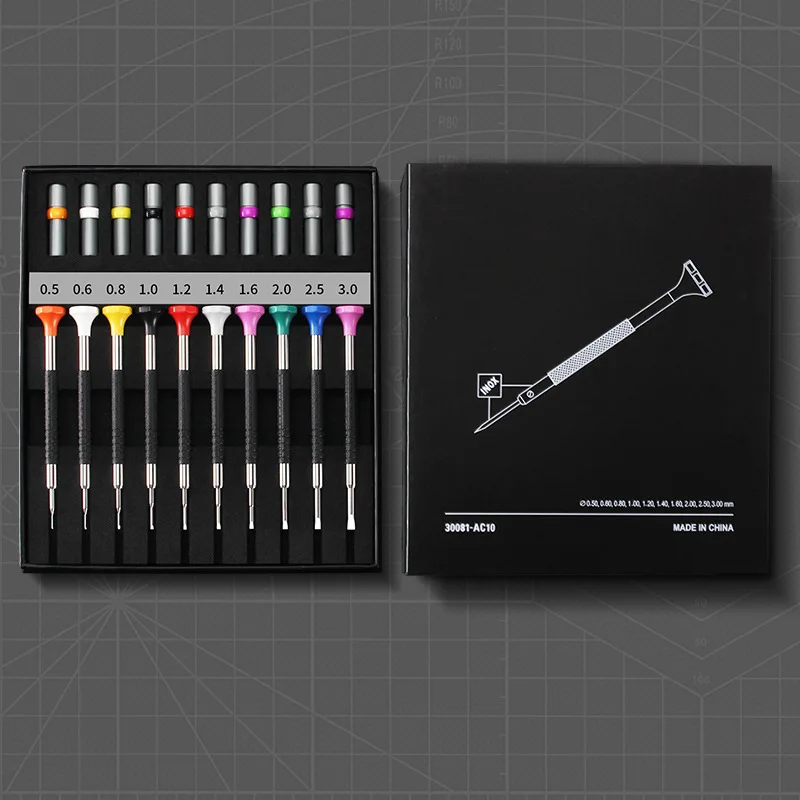
1. 10-Piece Boxed Bench Set (0.5 mm to 3.0 mm)
For bench assembly and case work requiring full coverage across sub-millimeter movement screws and heavier casing fasteners, this boxed set covers the widest breadth of standard metric flathead sizes (including 0.5, 0.6, 0.8, 1.0, 1.2, 1.4, 1.6, 2.0, 2.5, and 3.0 mm).
The set features individual color-coded swivel tops, knurled knurling along the shank, and dedicated storage compartments with spare blade tubes. It serves hobbyists who need a tidy, indexed workbench layout for both movement tear-downs and larger external case screws.
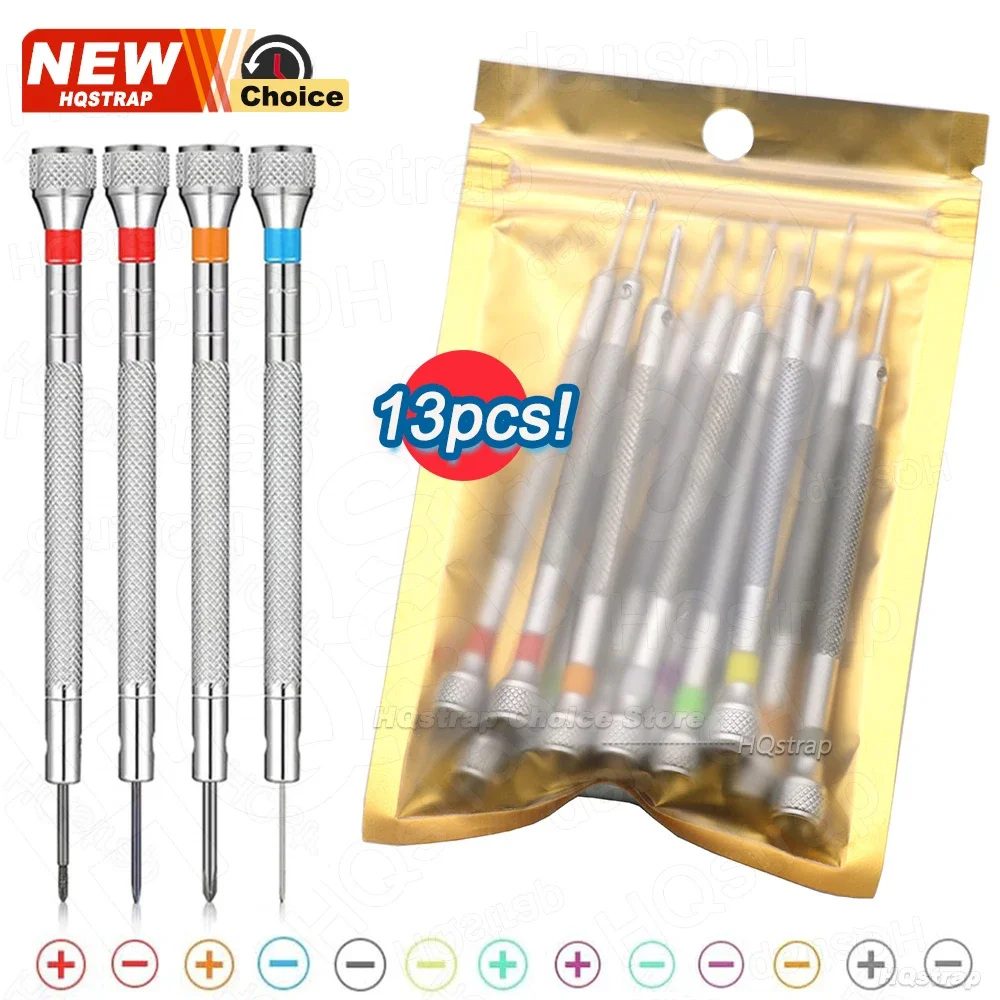
2. 13-Piece High Hardness Micro Set (0.6 mm to 2.0 mm)
For bracelet sizing, battery clamps, and intermediate movement screws, this multi-piece kit focuses heavily on the sub-2.0 mm range. It combines slotted profiles with miniature Phillips variants for hybrid repairs (such as quartz movements and modern digital case backs).
The knurled steel bodies offer reliable fingertip purchase, and the color-coded swivel tops streamline fast tip identification during repetitive disassembly tasks.
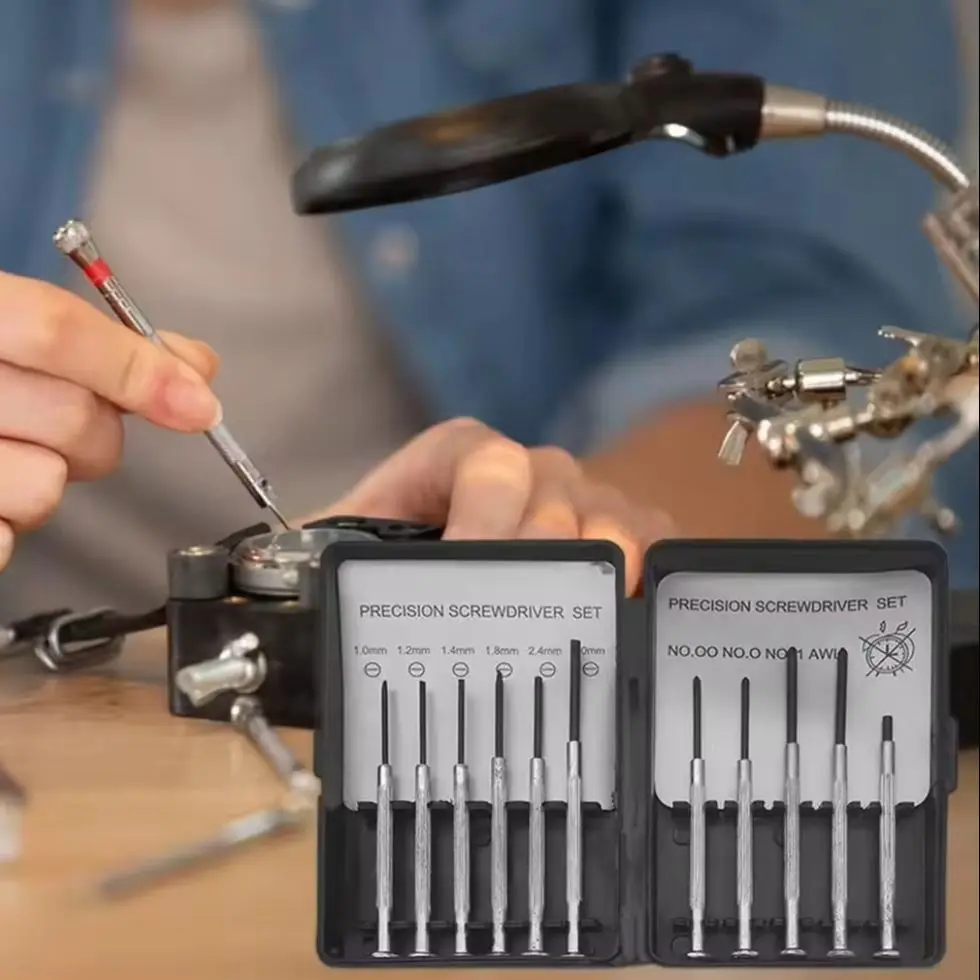
3. 11-Piece Hard-Case Starter Set
If you need an economical, self-contained kit for travel or basic household watch adjustments (such as changing quartz batteries or tightening loose case screws), this folding plastic-case set covers basic slotted sizes (from 1.0 mm upwards) along with small cross-head tips and an awl.
While the broader tips are less suited for sub-millimeter movement bridges, it provides a compact solution for external fasteners, glasses, and general mini-repairs.
Comparison: Choosing the Right Configuration
| Set | Size Range | Format | Best Suited For |
|---|---|---|---|
| 10-Piece Boxed Set | 0.5 mm – 3.0 mm | Fitted bench box + spare tubes | Movement service & general bench repair |
| 13-Piece Steel Set | 0.6 mm – 2.0 mm | Pouch / Multi-pack | Bracelets, quartz clamps & micro fasteners |
| 11-Piece Folding Set | 1.0 mm – 3.0 mm + Cross/Awl | Hinged travel case | Basic case screws, eyewear & toolkits |
Practical Care and Blade Dressing
Even high-grade steel screwdrivers require maintenance over time:
- Never Force a Fit: If a blade wobbles inside the screw slot, step up one increment (e.g., from 1.0 mm to 1.2 mm). Forcing an undersized blade will shear slot edges.
- Dress Your Blades: If a tip chips or rounds off, use a screwdriver sharpening guide roller over a medium/fine Arkansas or India oil stone to re-establish a square, parallel blade face.
- Keep Blades Demagnetized: Steel tools can pick up stray magnetic charges from motors or electronics. Pass your screwdrivers through a basic pass-through demagnetizer before touching mechanical balance assemblies or hairsprings.